
Hot As A Firecracker
I sold the FedEx IPO in 1978, while the founder was sitting down the hall in my office. Watching SpaceX go public this month, I realized how little — and how much — has changed

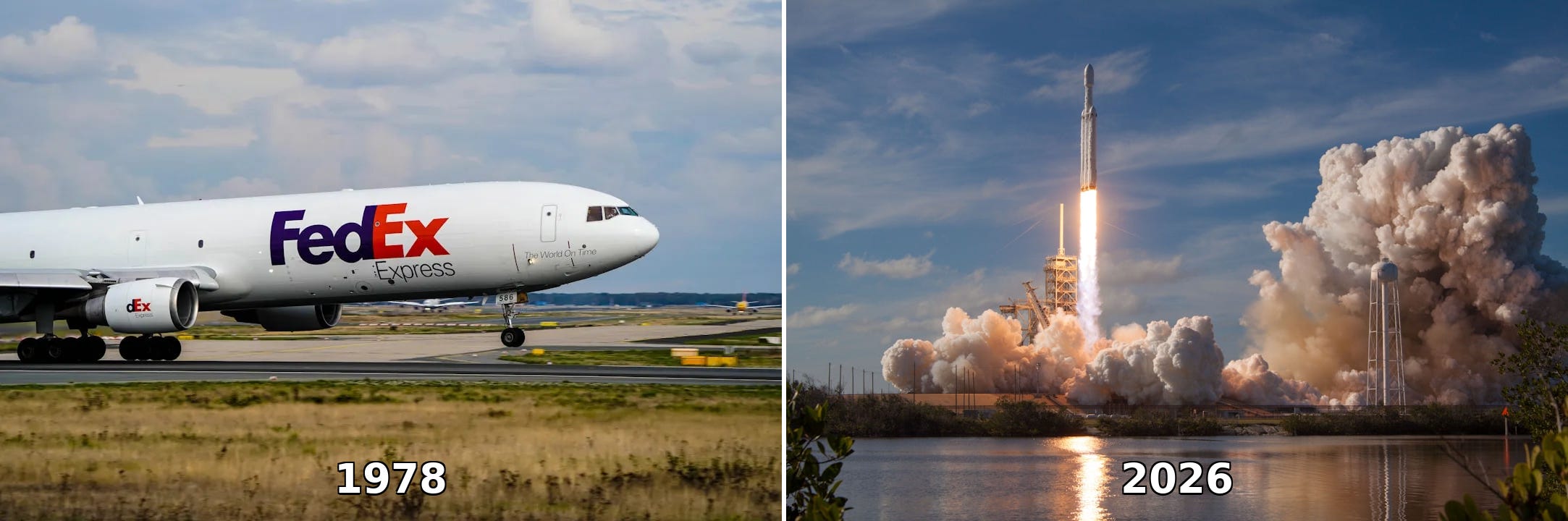
It was a clear blue, nippy Atlanta morning. I was twenty-seven years old, single, living alone in an apartment, and about as excited as a young man can be on his way to work. I was driving my sporty Camaro with fifteen minutes of ‘70s radio blasting, across the top of the perimeter on I-285, and I spent every one of them thinking about the day ahead. April 12, 1978. The day Federal Express went public — and the day, if you’d asked me, that I’d been waiting for since I’d gotten into this business a year before.
It was my first IPO. I was excited because it was not just any deal.
For a solid month we’d all known it was coming and so had the public — the significance of Federal Express wasn’t a secret. Some of us knew the deeper story, the one that’s since become legend: the Yale term paper laying out the whole idea, the one a professor supposedly graded a C. All that week we’d been getting ready to do the thing brokers live for — call our clients and our prospects and get them a piece of something hot. We didn’t know yet how many shares we’d be allowed to sell. The allocation was still up in the air.
And then, the night before, word came that tipped the whole thing into the surreal: Fred Smith himself — the founder — was coming to our office.
I should tell you what kind of office it was, because it matters. We were a new, small branch of Robinson-Humphrey — the old Atlanta brokerage — and we had no big producers, none of the million-dollar men you’d find downtown, just a handful of us still building our books, learning the trade. Our manager, Bill, ran the branch and carried his own book besides; in a place our size, the manager still had to produce. This was not where you’d expect the founder of the most talked-about company in the country to spend the morning his company went public. You’d expect him at the exchange, or downtown with the bankers, in one of the rooms where that kind of history is supposed to happen.
Instead, he came to us. He came because of Bill.
Bill and Fred had served in Vietnam together — helicopters were the thread that tied them, and Bill flew them — and they hadn’t laid eyes on each other since the war. How they’d found their way back into contact before that morning, I couldn’t tell you — there must have been a call somewhere along the way, because you don’t arrange what came next cold, but I wasn’t party to it and I won’t pretend I was.
When Fred arrived, he and Bill shook hands warmly and stood at the front desk and smiled and laughed while they chatted a bit although I was a bit out of ear range and couldn’t hear, something in the room shifted. The two took time to greet the rest of us warmly — handshakes all around, it felt celebratory. There was little small talk — and then the two of them went back behind a closed door, and that first stretch was not about stock at all. It was two soldiers picking up a thread dropped years before, the way men who served together do. The biggest business day of Fred Smith’s life, and the first order of business was the war.
The rest of us were left on the other side of the door with something better than a story to tell. We had the stock — and we had him, right there, down the hall.

Here I have to stop and explain something, because if you’re under a certain age, the thing we were all so excited about will look like nothing at all.
Today, if you want a package to cross the country by tomorrow morning, you tap a screen and it happens. A box appears on your porch overnight the way the sun comes up — so ordinary it’s beneath noticing. I need you to understand that in 1973, this was science fiction.
Before Federal Express, “fast” was a relative word. If you had something that absolutely had to get from Memphis to Cleveland in a hurry, your real options were the post office or air freight that rode in the belly of a passenger plane — flying on the airline’s schedule, not yours, changing hands between companies along the way, each hand-off another chance for it to sit on a dock or vanish for a week. There was no single company that picked your package up, controlled it the whole way, and put it in another person’s hands the next morning. The idea simply did not exist.
Fred Smith’s insight — the one that supposedly earned a C minus on a Yale term paper — wasn’t really about airplanes. It was about a shape - a concept. Instead of flying packages directly city to city, which sounds efficient and isn’t, you fly everything to one place in the middle of the country, in the dead of night, sort it all at once, and fly it back out before dawn. One hub, spokes radiating out to everywhere. Send a package from Cleveland to Cincinnati and it would fly through Memphis at two in the morning to get there. It sounds insane the first time you hear it. It is also the architecture that now moves seventeen million shipments a day and quietly underpins the entire world you order things in.
On the first night — April 17, 1973 — the whole revolution amounted to fourteen small French-built jets carrying 186 packages to twenty-five cities. That’s not a typo. One hundred eighty-six. A company that would one day move millions of packages a night began by moving fewer boxes than a single drugstore receives in a morning.
And it nearly died. For its first two years Federal Express bled something like a million dollars a month and ran up thirty million in losses. There’s a story — Smith told versions of it himself — that at one of the lowest points, turned down for funding and unable to make payroll, he took the company’s last few thousand dollars to a Las Vegas blackjack table and won enough to keep the doors open another week. Whether that’s literally true or polished by retelling almost doesn’t matter; it was that kind of close. The company we were about to take public, the one with the hot deal and the founder down the hall, had spent its early life one bad week from disappearing entirely.
That’s the part the excitement of that morning was built on, and it’s the part a younger reader has to feel to understand the rest. We weren’t selling shares in a delivery company. We were selling shares in an idea that had no right to have survived — and had.
The deal was hot as a firecracker. We’d half-expected it to be, but the demand still surprised us — and remember, 1978 was a graveyard for new issues; a deal this wanted was a rare animal. The allocation question that had been hanging over us all week resolved in our favor, and then some: because of Bill and Fred, our little branch got double the normal allotment per broker. Twice the ammunition. In an office full of young brokers still building their books, that was Christmas morning.
So, we got on the phones. And we had the single best opening line any of us would ever use. We told clients about the stock, and then we told them the thing no other broker in the country could: guess who’s sitting in our office right now. The founder. Here. Today. You couldn’t buy a sales pitch like that — proximity to the man himself, live, while he was down the hall.
But here’s the thing I remember most about those calls: they weren’t really sales at all. The first ones went to my best clients, the people who trusted me, and the calls were closer to celebrations than pitches. I wasn’t talking anyone into anything. I was handing people I liked a chance at a few more shares of something exciting, something everybody already wanted, something that felt like it was setting the trend rather than following it. The shares were so hot the call was simply good news — and there’s a quiet truth buried in that. The thing people claw over each other to get in an IPO, the hot allocation, reached my clients as a gift. It came down a chain of trust: Fred trusted Bill, Bill’s office got the shares, and my clients trusted me. Relationships, all the way down.
I wish I could show you what that day looked like: the room, the phones, all of it — but this was 1978. There were no cameras in our pockets. The only record of that morning is the one I’m writing down now, fifty years later, from memory.
There’s one more thing from that day, and it’s the part I’ve turned over the most in the years since — which is exactly why I have to be careful telling it.
I’ve told this story a lot. Over a long career and a longer life, the good ones get told and retold, and somewhere in the retelling the edges soften, and you stop being sure which version actually happened, and which is the one you’ve polished by saying it so often. So let me separate what I know from what I only remember.

What I know is the substance, and the history bears it out. Fred Smith’s father died when Fred was a boy, leaving a fortune in a family trust. When Federal Express was drowning in those early years — losing a million dollars a month, weeks from folding — Fred reached into that trust for the money to keep it alive. His sisters thought the idea was crazy, and when he did it, it cost him: there were lawsuits, family against founder, over the very money that saved the company. He bet his family’s fortune on an idea the world had already graded a C - , because there was no other money that size anywhere, and the alternative was watching it die.
What I remember — or what I’ve told so often I can no longer fully separate memory from telling — is Fred talking about it himself. His sisters. Something close to four million dollars, by some accounts. The trust raided early, when everyone around him thought he was out of his mind. Whether I heard those words from him directly in that office, or caught them through Bill, or assembled them over the years from that day and everything I’ve read since, I honestly can’t swear to anymore. Fifty years does that. But what stays with me is this: a man who’d just taken his company public — who’d won, publicly, that very morning — was, as I remember him, still turning over the cost of the bet. Not gloating about the victory. Reckoning with what it had taken.
That’s the Fred Smith I carry. Not the billionaire the obituaries would describe one day. A man who’d gone all the way to the edge, pulled his own family to it with him, and never quite stopped feeling the weight of that — even on the morning it all paid off.
He left in the middle of the afternoon. He and Bill came out from behind the door, and Fred made his way around the office, once again shaking every hand, thanking people he’d met only that morning. Then he was gone — back to Memphis, back to the company he’d nearly died building, on to the fifty years of it that were still ahead of him.
I got a handshake coming in and a handshake going out. In between, I’d spent the biggest day of my young career on the outside of a closed door, selling the stock of the man behind it. It was the best front-row seat I’d ever have in the business.
I thought about all of this a few weeks ago, when Space X went public.
The biggest IPO in history — tens of billions raised, the stock leaping on its first day, Elon Musk a trillionaire by the close. Somewhere out there, I promise you, was a twenty-something watching it happen on the phone in their pocket, electric about it, certain they were seeing the future arrive. Reusable rockets: the impossible idea of our moment, the one that’ll be wallpaper to the next generation, the way overnight delivery became wallpaper to this one.
Almost everything has changed. We sold shares from a small office over the phone; today it’s an app and an account minimum. We had paper and quote machines; they have a screen that shows the price moving in real time. But the thing underneath hasn’t changed at all. A hot deal still pops on day one, leaving money on the table the way ours did. The cheap shares still flow to whoever’s closest to the people handing them out — in 1978 that was a favor between two men who’d served together; in 2026 it’s a different set of rules, but it’s the same question. Who gets in early, and why. It always comes back to who you know and who trusts whom.
Fred Smith died on June 21, 2025, at eighty years old. A year ago this week.
Federal Express went public at twenty-four dollars a share. I remember it trading up that first day — into the mid-twenties, the firecracker doing what firecrackers do — though after fifty years I won’t swear to the exact close. What I can tell you is what those shares became. Through every split and every year since, a thousand dollars put into that IPO would have grown into something north of three hundred thousand. The idea that had no right to survive made fortunes for the people who believed in it early.
But that’s not what I think about when I think about that day. I think about a clear blue Atlanta morning, a sporty Camaro flying along on the perimeter, a twenty-seven-year-old who couldn’t believe his luck. I think about two soldiers behind a door, picking up a conversation the war had interrupted. And I think about the founder shaking my hand on his way out — a man who’d bet everything, including things that weren’t entirely his to bet, on a C-minus idea that changed the world.
Guess who was sitting in our office that day.
I was.
What a story! Nice!
Great article!