
Your Body Doesn't Recover While You Sleep. It Builds.
What happens during the eight hours that quietly shape the other sixteen


Here’s something worth sitting with before you read another word:
Your body doesn’t recover while you sleep. It builds.
Every hormone reset, every memory filed away, every immune cell replenished, every bit of emotional processing your brain couldn’t finish during the day—that’s active construction work, running on a biological schedule most of us spend our lives disrupting.
We’ve been thinking about sleep all wrong.
Not as a lazy metaphor—but literally, structurally wrong.
We treat sleep like a charging cable. Plug in, top up, unplug, go.
But that framing misses almost everything important about what’s actually happening.
Sleep isn’t maintenance.
It’s manufacturing.
And when you skip it, delay it, fragment it, or medicate your way into a shallow version of it, the factory doesn’t just slow down. It starts cutting corners on things you won’t notice until later.
There were periods during my financial services career when long hours felt like a badge of honor. Like many professionals, I convinced myself that pushing harder was giving me an edge. Looking back, I wasn’t gaining an advantage nearly as often as I thought. I was frequently operating with less patience, less clarity, and poorer judgment than I realized at the time.
That’s one reason this subject interests me today.
So let’s talk about what’s actually going on—and more importantly, what you might be telling yourself that’s quietly making it worse.
The Stories We Tell Ourselves
Most chronically sleep-deprived people aren’t in denial.
They know they’re not sleeping enough.
What keeps them stuck are the small, plausible stories they use to make it feel manageable.
“I’ll catch up on the weekend.”
It’s the most common one, and the most seductive, because it feels like a plan.
But the hours you lost on Wednesday aren’t sitting in a savings account waiting to be reclaimed on Saturday.
Researchers call the pattern of burning through the week and overcompensating on weekends social jet lag.
Your internal clock never fully resets.
You’re always slightly out of sync.
And it shows.
“A drink helps me wind down.”
This one is harder to let go of because it’s partially true.
Alcohol is a sedative.
It often helps you fall asleep faster.
What happens afterward is the problem.
As it moves through your system, it fragments sleep, suppresses REM sleep, and interferes with some of the deepest restorative stages of the night.
You may spend eight hours in bed and still wake up feeling behind before the day even starts.
The nightcap isn’t helping you sleep.
It’s helping you lose consciousness.
Those are not the same thing.
“I function fine on less.”
This may be the most dangerous story of all.
Sleep deprivation specifically impairs your ability to recognize that you’re impaired.
People who are chronically under-slept often believe they’re functioning normally while objective testing shows otherwise.
You’re not functioning fine.
You’ve simply forgotten what fine feels like.
In a recent article, Why Exhaustion Is Costing You More Than You Think, I wrote about the hidden consequences of fatigue and how poor sleep quietly affects decision-making, emotional control, and performance.
That raises a different question:
What is sleep actually doing when we finally give our bodies the chance to do it properly?
What Sleep Is Actually Building
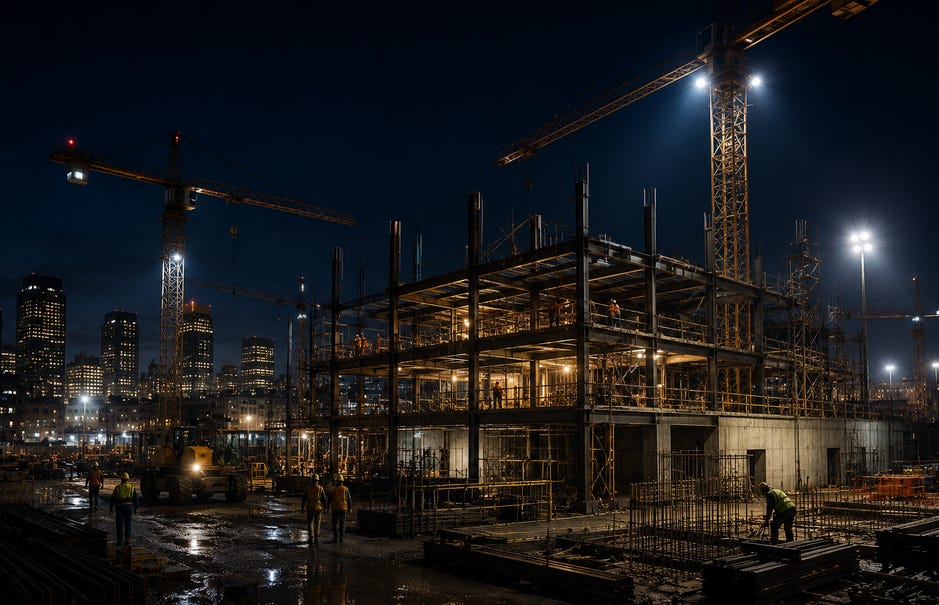
When you sleep well—genuinely, consistently well—your body runs a series of processes that simply cannot happen any other way.
Your brain runs a nightly cleaning cycle, flushing out metabolic waste products that accumulate during waking hours.
Your endocrine system resets hormone levels that govern energy, mood, appetite, and stress response.
Your immune system manufactures and deploys the cells it uses to fight infection and repair tissue damage.
And your memory—not just facts, but skills, emotional experiences, and creative connections—gets consolidated in ways that make the next day’s thinking sharper and more flexible.
None of this is optional.
None of it has a workaround.
You can take supplements, optimize your diet, and train five days a week.
All of that matters.
But if the nightly construction work isn’t happening properly, you’re building on an unstable foundation.
Eventually something shows the strain.
Because sleep isn’t simply recovery.
Sleep is construction.
Every night your body begins a new shift.
The question is whether you’re giving it enough time to finish the job.
The Weight Connection Nobody Talks About
Here’s an angle that deserves far more attention than it gets:
If you’ve been struggling with your weight and haven’t looked seriously at your sleep, you may be missing one of the most important variables in the equation.
When you’re sleep deprived, two hormones shift in ways that work directly against you.
Leptin—which signals fullness—drops.
Ghrelin—which triggers hunger—rises.
The result is increased hunger, increased cravings, and a stronger pull toward calorie-dense foods.
Not because you’re weak.
Not because you’ve suddenly lost discipline.
Because biology has changed the playing field.
Sleep deprivation also affects insulin sensitivity and the way your body processes nutrients.
The same meal can create a different metabolic response depending on how well rested you are.
Think about that.
Same food.
Same choices.
Different outcome.
Sleep is the missing variable in more weight-loss conversations than most people realize.
And unlike many solutions being sold today, it’s free.
The Professional Cost Is Measurable
If the personal case hasn’t fully landed, consider the professional one.
Poor sleep affects reaction time.
Judgment.
Creativity.
Strategic thinking.
Emotional regulation.
Communication.
You can still show up.
You can still put in the hours.
But if you’re chronically under-slept, you may be operating well below your true capacity without realizing it.
That’s one reason insufficient sleep costs businesses and economies billions of dollars every year.
The effects are subtle enough to ignore in the short term.
But significant enough to matter over years and careers.
What Actually Moves the Needle
None of this requires a radical reinvention of your life.
A few consistent changes make the biggest difference.
Anchor your wake time.
More than any other variable, waking at the same time every day stabilizes your circadian rhythm.
Revisit the nightcap.
Try moving alcohol earlier in the evening and notice what happens to your mornings.
Make your bedroom work for you.
Cool.
Dark.
Screen-free.
Build a real transition.
Twenty minutes of something genuinely calming before bed isn’t a luxury.
It’s the bridge between the pace of your day and the stillness your nervous system needs to let go.
As I’ve been researching and writing about this topic, I’ve found myself paying more attention to consistency than perfection.
If I were starting with only one change, it would probably be a consistent wake time.
It’s simple.
It’s measurable.
And it affects almost everything else downstream.
The Thing You Keep Skipping
The thing most likely to meaningfully improve your health, your weight, your energy, and the quality of your thinking is free.
Available tonight.
And requires nothing except the decision to take it seriously.
Most people read something like this, nod in agreement, and then stay up too late anyway.
The pull of one more episode, one more scroll, one more email feels immediate.
The benefits of sleep feel abstract.
Until they don’t.
The people who finally begin treating sleep with the same intentionality they bring to work, investing, fitness, or personal growth often report the same thing:
Sharper mornings.
More stable moods.
Less resistance to difficult tasks.
A body that feels like it’s working with them instead of against them.
And almost without exception, they end up asking the same question:
Why didn’t I take this seriously sooner?
If you read my earlier article, Why Exhaustion Is Costing You More Than You Think, that piece explored the consequences of chronic fatigue.
This article explores what is happening behind the scenes while you sleep.
They’re really two sides of the same conversation.
One is about the cost of missing sleep.
The other is about the value of getting enough of it.
Your body doesn’t recover while you sleep.
It builds.
I simply can’t love this article enough. You’ve positively nailed every point. Thank you for sharing. I’m grateful sleep is finally coming into the ether of conversation. Finally!
thank you!